Lesson 3 Homework
Index |
Lesson 1 | Lesson 2
| Lesson 3 | Lesson
4 | Lesson 5
| Lesson 6
Wuerzburg
- Germany
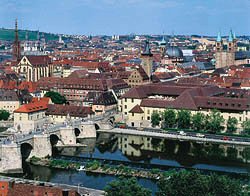 Wuerzburg
is theCapital of Lower Franconia in Bavaria Germany and located on both sides
of the River Main, amid huge parks and wine covered hills. In 1973 Würzburg
received the "European Award" and the title "European City".
Sister cities: Bray / Ireland, Caen / France, Dundee / Scotland, Mwanza / Tanzania,
Rochester N.Y. / USA, Otsu / Japan, Salamanca / Spain, Suhl / Thuringia and
Umeå / Sweden. Würzburg is the centre of the Franconian wine-growing
region. Three of Germany’s largest estates are located here (Staatlicher
Hofkeller, Bürgerspital zum Heiligen Geist, Juliusspital). Franconian wine
in the typical "Bocksbeutel" (bottle) may be tasted in numerous little
taverns. Please click on any of the photographs for more information.
Wuerzburg
is theCapital of Lower Franconia in Bavaria Germany and located on both sides
of the River Main, amid huge parks and wine covered hills. In 1973 Würzburg
received the "European Award" and the title "European City".
Sister cities: Bray / Ireland, Caen / France, Dundee / Scotland, Mwanza / Tanzania,
Rochester N.Y. / USA, Otsu / Japan, Salamanca / Spain, Suhl / Thuringia and
Umeå / Sweden. Würzburg is the centre of the Franconian wine-growing
region. Three of Germany’s largest estates are located here (Staatlicher
Hofkeller, Bürgerspital zum Heiligen Geist, Juliusspital). Franconian wine
in the typical "Bocksbeutel" (bottle) may be tasted in numerous little
taverns. Please click on any of the photographs for more information.
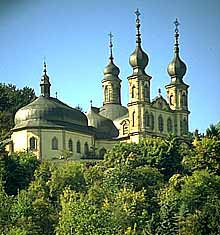
Marienkapelle "Kaeppele"
Late Gothic chapel of the patricians, begun in 1377, completed about 1480. Rich
ornamental sculptures, especially in portal arches (portal statues of "Adam
and Eve", originals at the Mainfränkisches Museum), interior renovated
after fire in 1945, noteworthy is the "Beautiful Madonna",around 1420,
numerous tombstones of Franconian knights and townsmen, among them Riemenschneider’s
tombstone of Konrad von Schaumberg. Tombstone of the great Baroque architect
Neumann at the portal facing the market square.
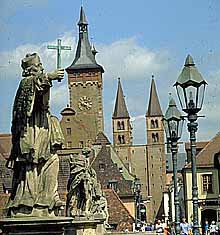
Alte Mainbrücke Grafeneckhart and Town Hall. This
Bridge was built 1473 –1543 replacing the destroyed Romanesque bridge.
Adorned with the well-known statues of saints about 1730. Grafeneckart and Town
Hall, originally office of bishops’ administrator, Romanesque tower and
impressive hall (Wenzelsaal), 13th Century. Since 1316 used as town hall, widened
several times. Adjacent is a red building built in 1659 by Preiss and Villinger
in late Renaissance style. In front of the Grafeneckart we find the Baroque
Vierröhrenbrunnen (fountain), built about 1765 by L. v. d. Auvera and Peter
Wagner.
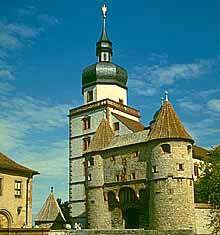
The Castle Marienberg, an originally fortified
retreat of the Hallstatt period (about 1000 b.C.). 706: consecration of the
Marienkirche. About 1200: foundation of the fortress. 1253 – 1719: residence
of the Princebishops. 1482: main castle was encircled by medieval ring-wall
with the Scherenberg gate. About 1600: Julius Echter rebuilt the fortress into
a Renaissance palace, Echter bastion was built. The charming fountain temple
above the deep well (104 meter) was built simultaneously. After the conquest
by Gustav Adolf of Sweden in 1631, the fortress was reconstructed as a Baroque
fortification and a princely park was laid out. The Baroque armoury, built 1702
– 1712, houses the Mainfränkisches Museum since 1947, excellent collection
of Franconian works of art, including the world-famous sculptures by Tilman
Riemenschneider. Prehistoric collection, exhibits of Franconian viticulture.
.
©Anita Wyatt 2004
If you would like to use something from this site, please contact
me for permission
This page was updated on September 12, 2004